

Executive Summary
Canadian employers have a legal duty to accommodate workers to the point of undue hardship, and must co-operate in return-to-work (RTW) and re-employment processes where workers are injured at work. What organizations often lack is a single source of truth that translates clinical restrictions into specific job tasks, documents suitable work, and produces a clear audit trail that stands up to human-rights and workers’ compensation scrutiny. ErgoWorks solves this gap by pairing accurate job profiles with a one-page accommodation job-match worksheet that drives consistent, timely, and legally defensible decisions.
Why the Status Quo Fails Employers
Most RTW programs are fragmented with outdated job descriptions and scattered clinical notes that don’t map to actual job demands. That fragmentation may delay decisions, inflates costs, and expose employers to procedural failures under the duty to accommodate (where failing to thoughtfully consider options can itself breach the law). ErgoWorks replaces guesswork with standardized job intelligence and a single accommodation worksheet, so everyone—from HR and supervisors to clinicians and insurers—works from the same facts.
Bridges Health has documented organizations using ErgoWorks achieving up to 360% ROI through faster decisions and shorter claim durations.
1) Duty to Accommodate (Human Rights)
Across Canada, employers must adjust policies, practices, and workplaces so otherwise fit employees are not unfairly excluded, up to undue hardship, typically assessed on cost and health and safety, with some jurisdictions also considering outside funding. The procedural duty, meaning a thoughtful and individualized assessment, is as important as the substantive outcome, which is the accommodation itself.
The Supreme Court has confirmed there are limits. When, despite reasonable measures, an employee cannot fulfill basic job obligations in the reasonably foreseeable future, the duty may be met, as clarified in Hydro-Québec (2008 SCC 43) and explained by Canadian employment law firm Lawson Lundell in its analysis of undue hardship and accommodation standards (lawsonlundell.com). Employers must demonstrate evidence-based undue hardship. “Impossible to accommodate” is not the legal test.
2) Workers’ Compensation & Return-to-Work (Ontario example)
WSIB policies require workplace parties to co-operate in RTW: early contact, maintained communication, and identifying suitable work consistent with the worker’s functional abilities, with penalties for non-cooperation. Certain employers also have re-employment obligations (e.g., 20+ employees, 12+ months continuous employment), including offering essential duties when medically able or the first suitable job when not.
3) Privacy
When handling medical or functional information, organizations must comply with PIPEDA requirements, or applicable provincial privacy laws, including identifying purposes, limiting collection, applying appropriate safeguards, and ensuring consent or notification. These obligations are especially important when employee monitoring is involved or when storing sensitive health data used in accommodation decisions, as outlined by the Office of the Privacy Commissioner of Canada (priv.gc.ca).
How ErgoWorks Works
Step 1: Create Clear Job Profiles (the foundation)
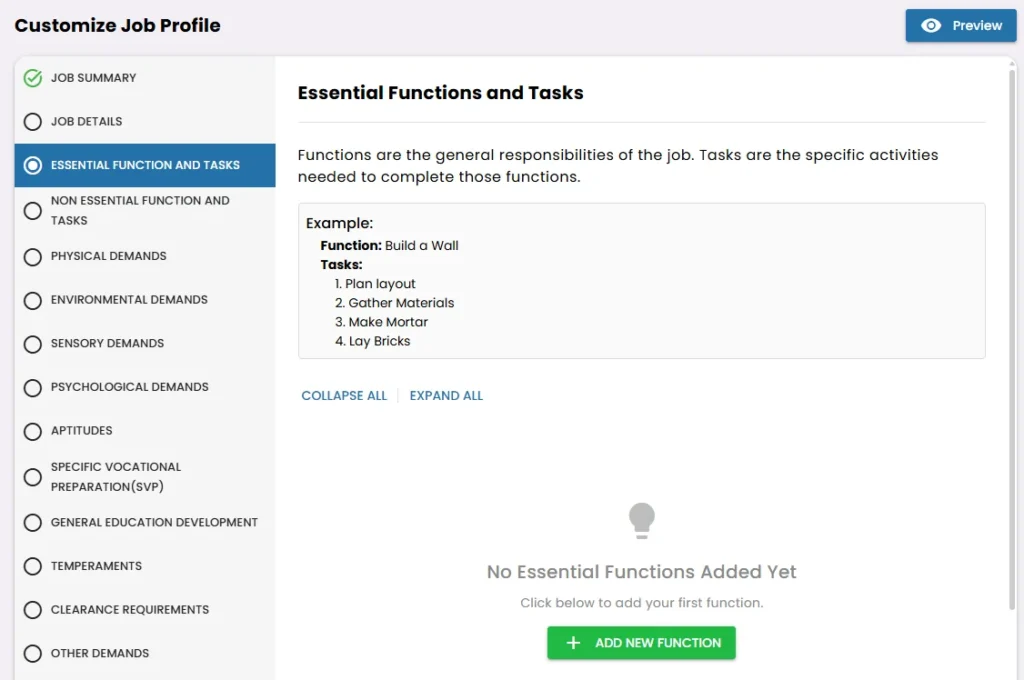
ErgoWorks guides employers to capture task-level demands (postures, forces, repetitions, environmental exposures, cognitive load) and essential duties versus non-essential duties. This precision is critical to the duty to accommodate and WSIB’s “suitable work” requirement, because suitability depends on matching functional abilities to specific tasks that are safe and productive.
Step 2: Translate Medical Restrictions into Functional Abilities
Clinicians and case managers input functional abilities (e.g., lift ≤ 10 kg, avoid sustained kneeling, cognitive pacing limits). ErgoWorks structures this data so it can be directly compared to the job profile’s task demands, satisfying the procedural duty to accommodate by demonstrating a thoughtful, individualized analysis.
Step 3: Use the Single Accommodation Job-Match Worksheet (decision anchor)
ErgoWorks generates a one-page worksheet that:
- States the worker’s functional abilities and restrictions (date-stamped, source-referenced).
- Maps those abilities to the essential job duties and non-essential tasks from the profile.
- Identifies suitable work (safe, productive, within abilities), including modified duties, hours, equipment, or environmental controls.
- Records the employer’s offers and the worker’s feedback, meeting WSIB co-operation and re-employment documentation expectations.
Why this matters:
- It creates an audit trail human-rights bodies expect (procedural + substantive).
- It shows that suitable work was identified/offered or explains—with evidence—why not.
Step 4: Protect Privacy & Access Controls
Role-based access, clear purpose limitation, minimal necessary data, and retention controls help employers align with PIPEDA and applicable provincial rules when storing health information used for accommodation.
What Employers Gain with ErgoWorks
Clarity: Up-to-date job profiles remove ambiguity about essential duties and task demands, making “suitable work” findings faster.
- Consistency: The single job-match worksheet standardizes decisions across sites and cases, strengthening procedural compliance.
- Defensibility: Decisions are evidence-based and aligned with undue hardship criteria (cost, health & safety, objective proof).
- Speed: Real-time collaboration reduces delays that increase claim durations and costs
How Insurers, Case Managers, and Clinicians Benefit
- Insurers/Case Managers: Immediate access to documented job demands and accommodation offers accelerates claims resolution and monitors co-operation duties.
- Clinicians: Functional abilities are meaningfully situated against real tasks, fostering recommendations that succeed in practice rather than remaining abstract.
Ready to move from fragmented files to one clear decision record?
ErgoWorks was built to give Canadian employers defensible clarity: accurate job profiles, a single accommodation job-match worksheet, and a shared view that eliminates uncertainty and speeds compliant RTW. Documented implementations have shown material ROI from reducing delays and claim duration.